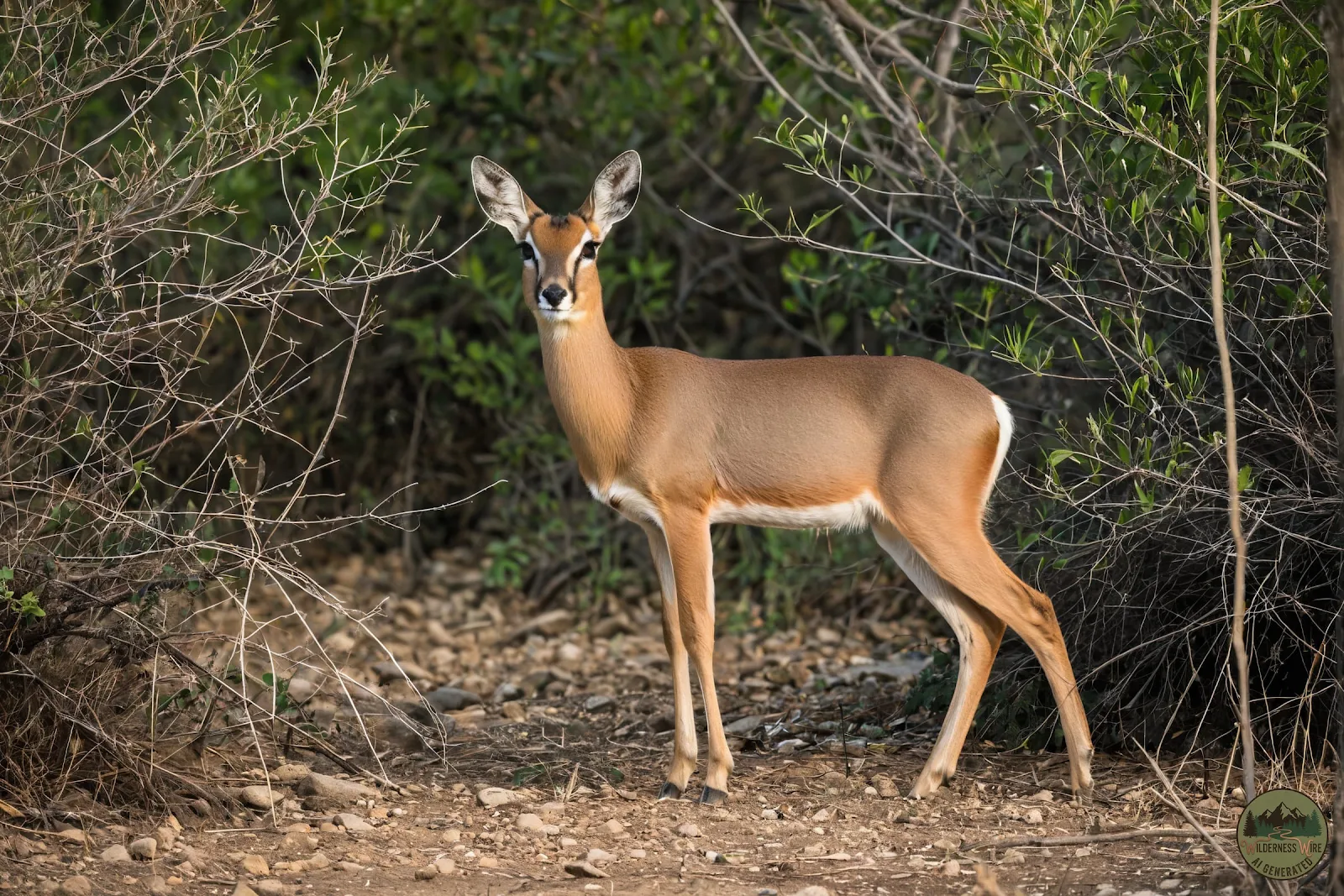
Deep within the diverse landscapes of Southern and Eastern Africa, a tiny, yet remarkably resilient antelope navigates its existence with an understated grace: the steenbok. Often overshadowed by the continent's larger, more charismatic megafauna, this diminutive creature embodies the essence of adaptation and survival in environments that demand ingenuity and stealth. Its name, derived from Afrikaans, literally translates to "stone buck" or "brick buck," perhaps hinting at its preference for stony, arid terrain or its unobtrusive, rock-like stillness when sensing danger.
Standing no more than 50-60 centimeters at the shoulder and weighing between 7 to 16 kilograms, the steenbok is a marvel of delicate proportions. Its coat typically displays a beautiful reddish-fawn to sandy-brown hue across its back and flanks, transitioning to a pure white on its belly and the underside of its tail. This countershading provides exceptional camouflage, allowing it to blend seamlessly into the sun-drenched grasslands, savannas, and open woodlands it calls home. Its most striking features include large, expressive dark eyes encircled by a pale ring, and remarkably prominent ears, which are acutely sensitive to the slightest sounds of approaching predators. Males are distinguished by their short, straight, sharply pointed horns, which can grow up to 13 centimeters long, used primarily for territorial defense against other males rather than as a primary defense against predators.
One of the steenbok's most extraordinary adaptations is its remarkable independence from surface water. Unlike many other antelopes that require regular visits to waterholes, the steenbok obtains almost all the moisture it needs directly from its diet. It is a selective feeder, thriving on a diverse menu of leaves, shoots, flowers, fruits, and particular grasses. However, its foraging behavior often extends beyond mere grazing or browsing. Steenbok are known to dig assiduously for underground bulbs, tubers, and roots, which are not only nutritious but also rich in water content. This specialized dietary strategy allows them to inhabit arid and semi-arid regions where water is a precious commodity, extending their range far beyond what would be possible for less adapted species. Their efficient metabolism further ensures that water loss through urination is minimized, cementing their status as true survivors of dry African landscapes.
These elegant antelopes are predominantly solitary creatures, a behavioral trait that likely enhances their ability to remain inconspicuous in their open habitats. While a male and female may occasionally be seen together, particularly during the breeding season, they do not form herds. Instead, each individual, or sometimes a breeding pair, maintains a defined territory, which is marked through scent glands and dung middens. This solitary existence minimizes competition for resources and reduces the chances of detection by predators, as a single animal is much harder to spot than a group. Steenbok are active throughout the day and night, though they tend to be more active during the cooler parts of the day – early mornings, late afternoons, and often under the cover of moonlight – to avoid the midday heat. During the hottest hours, they seek refuge in the shade of bushes or tall grass, often creating a shallow scrape in the earth to lie in, which offers a slight cooling effect and enhanced concealment.
Survival in the harsh African wilderness necessitates a keen sense of awareness and sophisticated defensive mechanisms. The steenbok's primary defense against its numerous predators, which include caracals, jackals, pythons, eagles, wild dogs, and leopards, is its exceptional camouflage and ability to remain perfectly still. When threatened, a steenbok will often freeze motionless, becoming virtually invisible amidst the vegetation. If the predator gets too close, it will suddenly bolt, dashing away in a rapid, erratic zigzag pattern that makes it incredibly difficult for a pursuing predator to track. This burst of speed and agility is often followed by another cunning tactic: dropping to the ground abruptly and hiding in thick cover, often looking back over its shoulder to assess if the threat has passed. An interesting, though less common, defensive behavior is the burying of its droppings in sand with its nose, a method believed to remove scent markers that could lead predators to its location.
Reproduction in steenbok typically results in the birth of a single fawn after a gestation period of approximately seven months. The newborn fawn, weighing only about one kilogram, is instinctively hidden by the mother in dense vegetation for the first few weeks of its life. This strategy minimizes the risk of predation at its most vulnerable stage. The mother will visit the fawn periodically to nurse, but otherwise leaves it concealed, relying on its natural camouflage and lack of scent to keep it safe. The fawn grows rapidly, becoming more independent as it matures, and will typically be weaned after about three months. Sexual maturity is reached around 6-9 months, though they usually breed later.
The steenbok plays a subtle yet important ecological role in its ecosystem. By selectively browsing and grazing, it helps to shape vegetation structure, preventing overgrowth in certain areas and contributing to the dispersal of seeds through its digestive process. Its digging behavior also aerates the soil and unearths nutrients. Classified as 'Least Concern' by the IUCN, the species is relatively widespread and stable across much of its range. However, local populations do face threats, primarily from habitat loss due to agricultural expansion and human encroachment, as well as poaching for bushmeat. Despite these pressures, the steenbok's adaptability, elusive nature, and capacity to thrive in diverse environments continue to ensure its presence as an enduring symbol of African wilderness. Its quiet existence is a testament to the power of specialized adaptations, allowing this small antelope to hold its own against the formidable challenges of its magnificent continent.