Springbok: Southern Africa's Leaping Icon of Resilience and Speed
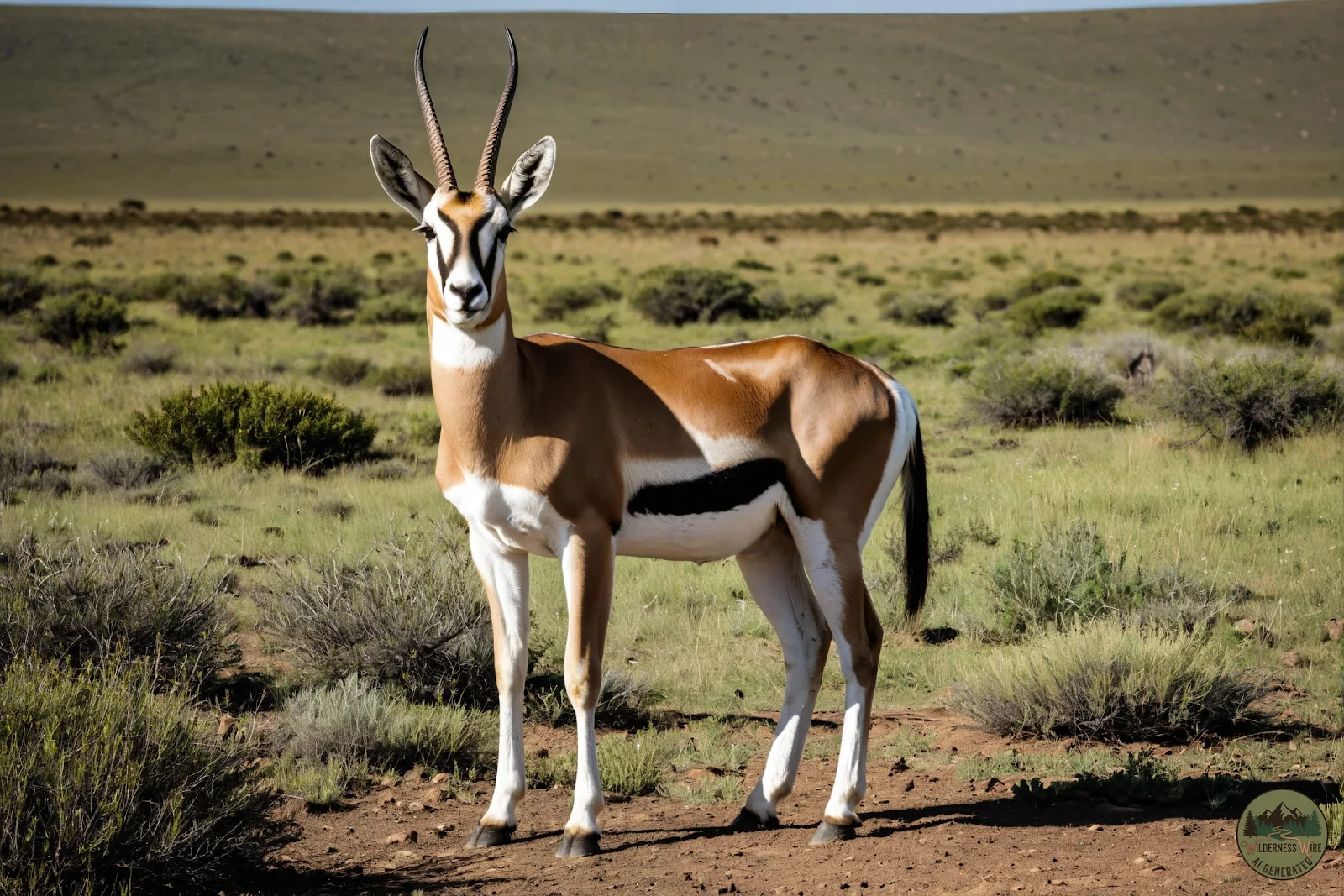
Distinguished by its vibrant coat, this antelope possesses a visually striking tripartite coloration. Its back is covered in a rich, reddish-brown fur, sharply contrasting with its pristine white underparts. A prominent dark reddish-brown stripe runs horizontally along each flank, separating the dorsal and ventral colors. The head is primarily white with a dark stripe extending from the corner of the eye to the muzzle. Both males and females bear slender, ringed horns, which spiral slightly backward and then forward, though those of the males are typically thicker and longer. A unique feature is a pouch-like skin fold running along its back, containing a crest of stiff, white hairs, usually hidden from view unless the animal is excited or displaying.
Perhaps the most captivating behavior of this antelope is its unique form of stotting, commonly known as pronking. When pronking, the animal executes a series of stiff-legged leaps, arching its back, and holding its head down.
During this display, the aforementioned dorsal crest of white hairs is fully erected, creating a fan-like visual effect that runs from its tail to its shoulders. The purpose of pronking has been a subject of scientific debate. Theories suggest it could be an alarm signal to other herd members, a display of fitness to predators, indicating that the individual is too agile to be worth pursuing, or simply an expression of exuberance. Regardless of its precise function, the pronk is an energy-intensive and spectacular sight, highlighting the animal's athleticism and vitality.
The antelope is perfectly adapted to its preferred habitats of open grasslands, savannas, and shrublands, particularly prevalent in areas like the Karoo and the vast Kalahari Desert. Its physiological adaptations allow it to thrive in these often-harsh conditions. It can subsist without surface water for extended periods, deriving sufficient moisture from the plants it consumes. This ability is critical during prolonged dry seasons when water sources are scarce. Its sleek build and long legs contribute to its incredible speed, capable of reaching up to 88 kilometers per hour (55 mph), making it one of the fastest antelopes and an expert at evading predators like cheetahs, lions, leopards, hyenas, and wild dogs.
Its diet is flexible and opportunistic, shifting between grazing and browsing depending on the availability of vegetation. While primarily a grazer, feeding on various grasses, it will readily browse on shrubs and succulents, especially when grasses are dry or during times of drought.
Succulent plants provide essential moisture, making them a crucial component of its diet in arid regions. Its migratory patterns are often dictated by the search for optimal forage and water, leading to localized movements across its range.
The social structure of this antelope is fluid and adaptable. During the non-breeding season, mixed-sex herds are common, sometimes numbering in the hundreds or even thousands in particularly favorable conditions. Males, however, may form bachelor herds, while females often gather into nursery herds when raising their young. During the breeding season, mature males become territorial, defending patches of ground to attract females. After a gestation period of approximately five to six months, a single fawn is typically born.
The young are precocial, able to stand and run shortly after birth, a vital adaptation for survival in environments teeming with predators. The fawns are initially hidden in dense vegetation by their mothers, only joining the larger herd after a few weeks.
Historically, this antelope was renowned for its massive seasonal migrations, known as "trekking," which involved herds numbering in the millions. These colossal movements, documented well into the 19th century, were legendary, creating a moving landscape of life that stretched for miles. While such massive migrations are no longer observed due to habitat fragmentation and human settlement, healthy populations persist across its range, primarily in South Africa, Namibia, Botswana, and Angola. Conservation efforts, combined with its robust adaptability, have ensured that it remains listed as 'Least Concern' by the IUCN, a testament to its resilience in the face of environmental pressures.
Beyond its ecological significance, this antelope holds considerable cultural importance in Southern Africa.
It is a national symbol of South Africa, appearing on various emblems, coins, and sports jerseys, representing the spirit, agility, and unique heritage of the nation. Its image evokes a sense of wildness and the untamed beauty of the African veld. Its ability to thrive in challenging environments and its iconic pronking display contribute to its status as a beloved and instantly recognizable icon of the continent's diverse wildlife.
In conclusion, this particular antelope is far more than just another herbivore in the African ecosystem. It is a masterpiece of natural selection, possessing a unique blend of physical beauty, remarkable adaptations, and captivating behaviors.
Its agility, speed, and the sheer spectacle of its pronk make it a constant source of fascination for observers, while its ecological role and cultural significance underscore its importance to both the natural world and human society in Southern Africa. It stands as a vivid reminder of the enduring power and beauty of the wild.