 Serval_00001_
A creature of elegant proportions and keen senses, the serval stands as one of Africa's most distinctive small to medium-sized wild cats. With its remarkably long legs, disproportionately large ears, and a coat adorned with striking spots, it possesses an unmistakable silhouette against the backdrop of its native grasslands and savannas. Far more than just a beautiful predator, the serval is a master of its environment, exhibiting a suite of specialized adaptations that allow it to thrive in the dynamic ecosystems of sub-Saharan Africa. Its presence is a testament to the intricate balance of nature, a highly efficient hunter playing a vital role in regulating rodent and bird populations.
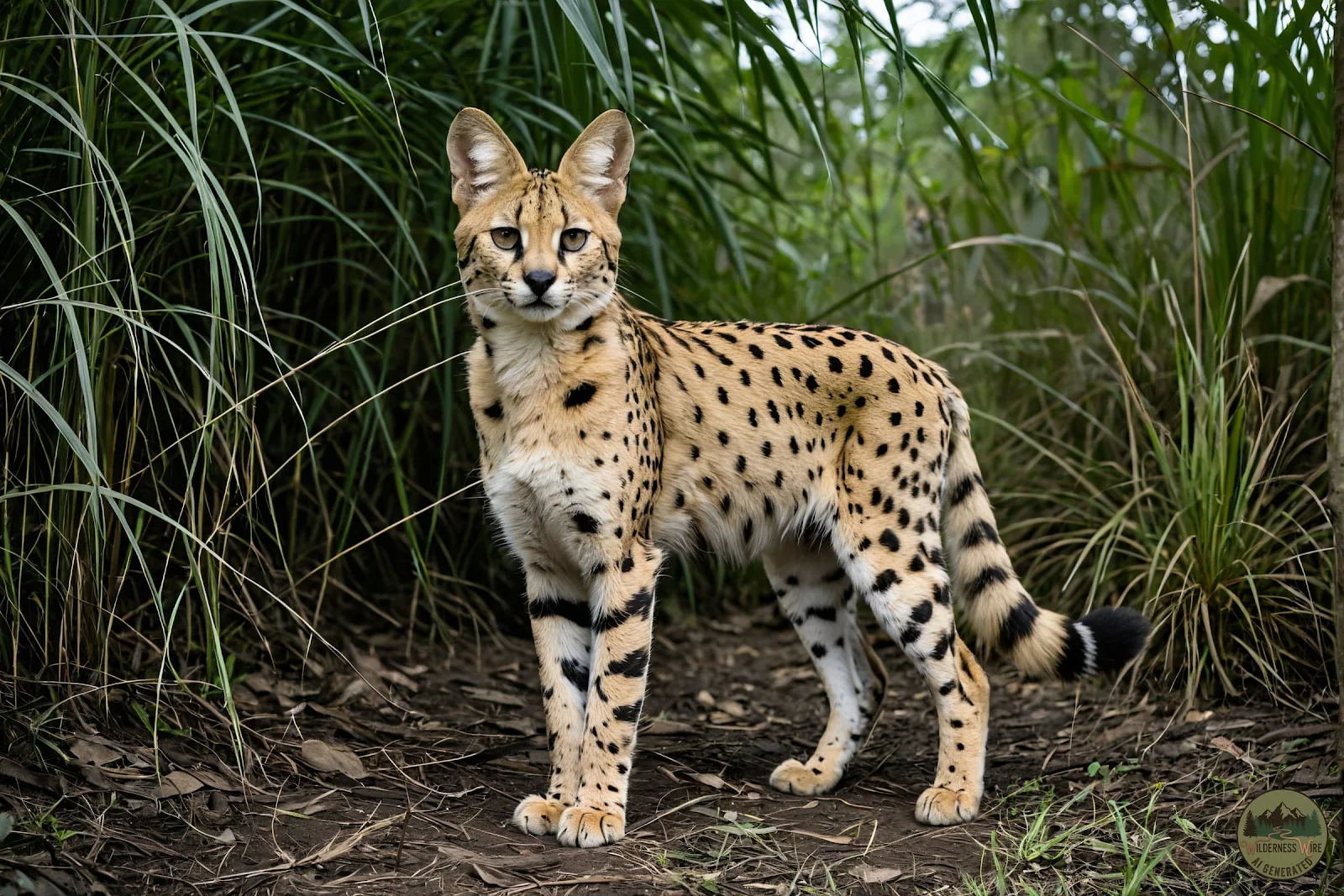
Perhaps the most striking feature of the serval is its elongated physique. Standing up to 60 cm (24 inches) at the shoulder, its legs are among the longest of any cat relative to its body size. This architectural marvel allows it to see over tall grasses, an invaluable advantage when scanning for prey in its preferred habitat. Its hind legs are slightly longer than its front legs, giving it a distinctive forward-sloping posture and enabling extraordinary leaping abilities. The coat, typically golden-yellow to tawny, is liberally patterned with black spots that often merge into stripes on the neck and back, providing superb camouflage amidst dappled sunlight and vegetation. The underparts are usually lighter, often white or cream. Another defining characteristic is its large, oval ears, which are independently mobile and can rotate up to 180 degrees. These ears are not merely large; they are finely tuned auditory instruments, crucial for pinpointing the exact location of prey even when hidden from sight.
The serval's domain spans much of sub-Saharan Africa, from the Sahel region in the north down to the Cape in the south, though it is absent from the true desert zones and the dense rainforests of Central Africa. Its preferred habitat is characterized by a mosaic of tall grasslands, savannas, and reed beds, always in close proximity to water sources such as rivers, swamps, and marshes. This affinity for water is a key ecological differentiator, allowing it to exploit wetland ecosystems that many other terrestrial predators avoid. While primarily a creature of the plains, it can adapt to various environments as long as there is sufficient cover and water, including bamboo thickets and even mountainous areas up to 3,000 meters (9,800 feet) in elevation. The availability of water supports the abundant small prey that forms the bulk of its diet, and the dense vegetation provides both hunting cover and refuge.
The serval is a highly specialized hunter, renowned for its incredible efficiency. Its unique physical attributes are all geared towards a specific hunting strategy: locating prey by sound and then striking with precision. Using its acute hearing, it can detect the faint rustle of a rodent or the subtle movement of a bird from a considerable distance, even underground. Once prey is detected, the serval often engages in a behavior known as "mouse-leaping" or a "vertical pounce." It can leap several meters into the air, sometimes as high as two meters (6.5 feet) horizontally and vertically, to bring down birds in flight or to pounce directly onto hidden rodents. This extraordinary agility allows it to capture prey that would be inaccessible to many other predators. Its diet consists overwhelmingly of small vertebrates, with rodents making up the vast majority. It also preys on birds, frogs, lizards, snakes, and insects. Larger prey like hares or small antelopes are occasionally taken, but these are rare exceptions. Unlike many felines, servals are known for their high hunting success rate, often catching over 50% of the prey they attempt to seize, a testament to their specialized tactics.
Servals are predominantly solitary animals, though mothers will raise their young alone. They are generally crepuscular, meaning they are most active during dawn and dusk, but can hunt at any time of day or night depending on prey availability and human disturbance. Each serval maintains a home range, which it marks with urine and feces, as well as by rubbing its scent glands against objects. The size of these territories can vary widely based on prey density and habitat quality, ranging from 10 to 30 square kilometers (4 to 12 square miles). Communication between servals is generally limited, but they do employ a variety of vocalizations, including purrs, growls, hisses, and a distinctive high-pitched chirping sound often used during courtship or distress.
Breeding can occur year-round, but peaks during the wet season when prey is most abundant. After a gestation period of approximately 67 to 77 days, a litter of one to four kittens is born in a secluded den, often an abandoned aardvark burrow, a dense thicket, or a rock crevice. The kittens are born blind and helpless, weighing only about 250 grams (9 oz). They open their eyes after about 9 to 13 days and are weaned at around 4 to 7 months. They remain with their mother for up to a year, learning essential hunting and survival skills before dispersing to establish their own territories. Sexual maturity is reached at around one to two years of age.
Despite their wide distribution, serval populations face increasing pressure across their range. The International Union for Conservation of Nature (IUCN) currently classifies the serval as "Least Concern," primarily due to its widespread presence and relatively stable populations in some areas. However, this status masks significant regional declines. The primary threat to servals is habitat loss and degradation, driven by human population expansion, agricultural encroachment, and urbanization. Their preferred wetland habitats are particularly vulnerable to drainage for farming or development. Human-wildlife conflict is another major issue; servals are sometimes hunted by farmers who perceive them as a threat to poultry or small livestock, despite the fact that their diet consists predominantly of wild prey. They are also sometimes trapped or hunted for their pelts in certain regions, although this trade has decreased significantly compared to historical levels. Additionally, road mortality and illegal pet trade pose localized threats. Protecting servals involves preserving their wetland and grassland habitats, promoting coexistence with local communities, and enforcing anti-poaching laws.
The serval occupies a crucial niche in its ecosystem as a mesopredator, helping to control populations of rodents and small birds. This role is vital for maintaining the health and balance of grassland and savanna ecosystems, preventing overgrazing by rodents and promoting biodiversity. Its specialized hunting strategy, with its emphasis on acute hearing and spectacular leaps, highlights an evolutionary path distinct from many other felines, which often rely more on stealth and powerful pursuit. Unlike many cats, servals are quite comfortable in water and are adept swimmers, a trait that further distinguishes them and allows them to exploit a broader range of prey, including aquatic insects and amphibians. Their striking appearance and remarkable adaptations make them a subject of fascination for researchers and wildlife enthusiasts alike, symbolizing the intricate beauty and resilience of African wildlife.