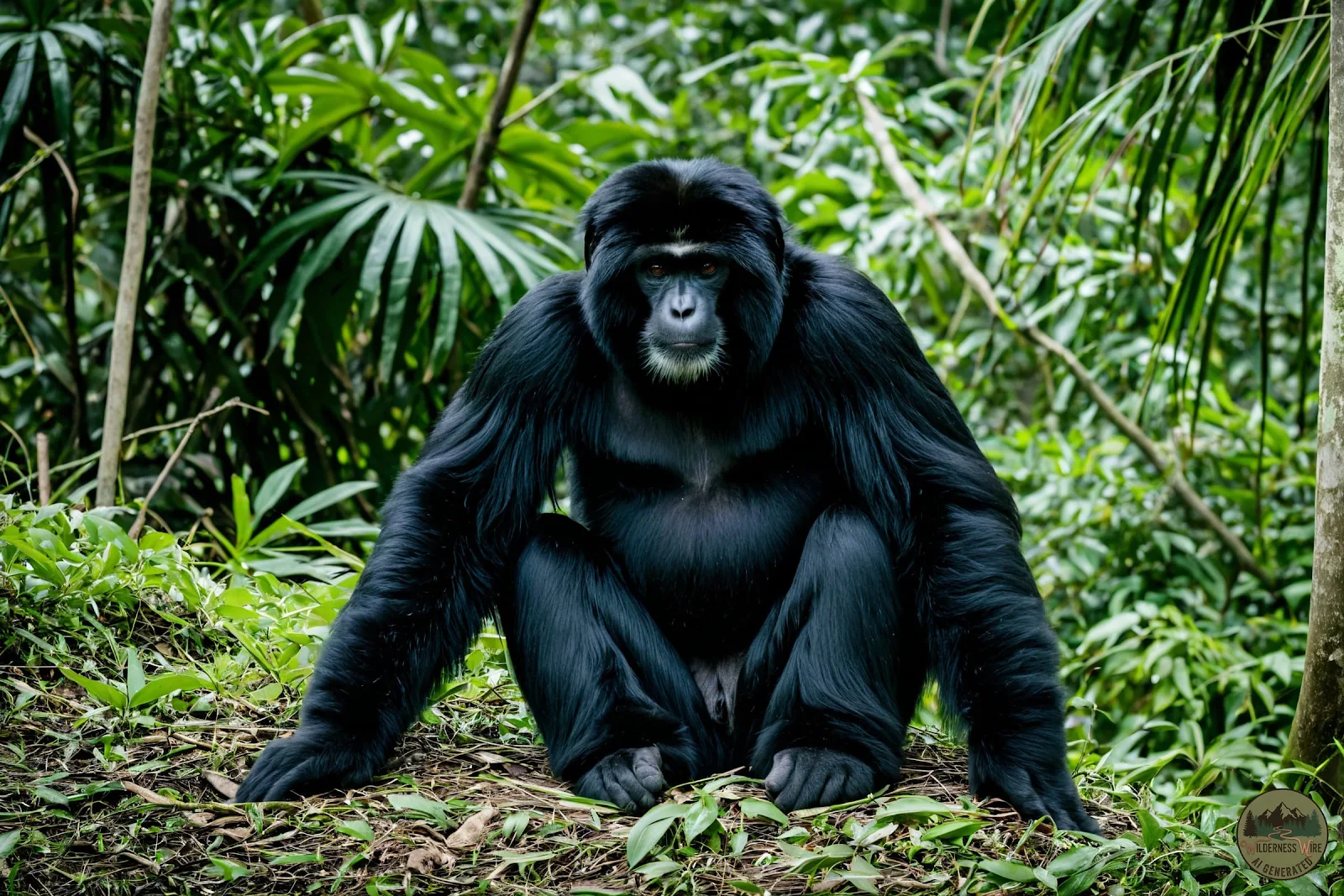
High above the forest floor, in the dense, emerald canopies of Southeast Asia, resides a remarkable primate known as the siamang. Distinguished as the largest of the gibbons, this enigmatic ape is a master of its arboreal domain, navigating the rainforest with an agility and grace that few other creatures can rival. Its striking appearance, coupled with its extraordinarily complex vocalizations, makes it a truly unique inhabitant of these vital ecosystems, serving as an emblem of the wild, untamed beauty of its ancient forest home.
Siamangs are instantly recognizable by their sleek, shaggy black fur and the prominent, hairless gular sac located beneath their chin. This remarkable anatomical feature, often referred to as a throat pouch, is a key component of their communication strategy, inflating dramatically to amplify their calls, which can carry for several kilometers through the dense jungle. These vocalizations are not merely random noises; they are intricate duets performed by breeding pairs, a sophisticated form of communication that serves to reinforce pair bonds, signal territorial claims, and warn rivals of their presence. Each species of gibbon has its unique song, and the siamang's repertoire is particularly complex, often involving long, resonant hoots, barks, and gurgles that echo through the dawn or dusk hours, creating an ethereal soundtrack to the rainforest.
Physically, the siamang is built for life in the trees. Its arms are disproportionately long, often twice the length of its torso, equipped with powerful muscles and highly mobile shoulder joints that facilitate its primary mode of locomotion: brachiation. This swinging motion, a true spectacle of arboreal acrobatics, allows them to travel swiftly and efficiently from branch to branch, covering distances of up to ten meters in a single swing. Their hands are long and slender, with opposable thumbs, perfectly adapted for gripping branches, while their feet also possess a degree of grasping ability, providing additional security as they navigate their lofty world. Uniquely among gibbons, siamangs possess a slight webbing between their second and third toes, though the precise adaptive advantage of this feature remains a subject of scientific inquiry.
Siamangs are highly social, typically living in small, stable family groups consisting of a monogamous breeding pair and their offspring. These family units are intensely territorial, meticulously defending their home range against intruders. This defense often involves impressive displays of vocal prowess, with the male and female performing their coordinated duets to signal their presence. Beyond vocalizations, territorial disputes can escalate to physical confrontations, though these are rare and typically involve only brief chases or threats. Grooming plays a crucial role in maintaining social bonds within the group, reinforcing hierarchies and fostering a sense of cohesion.
Their diet primarily consists of fruit, making them important seed dispersers within the ecosystem. However, they are also highly adaptable, supplementing their frugivorous diet with young leaves, flowers, buds, and even insects, birds’ eggs, and small vertebrates when fruit is scarce. This dietary flexibility allows them to thrive across various seasons and availability of resources. They spend a significant portion of their day foraging, meticulously searching for ripe fruits and tender foliage, contributing to the health and regeneration of the forest.
The natural habitat of the siamang spans the rainforests of the Malay Peninsula and the Indonesian island of Sumatra. They prefer primary and secondary lowland and montane tropical forests, where the dense canopy provides both ample food resources and protection from predators. Within these forests, they play a vital ecological role. By consuming fruits and then depositing seeds in new locations through their droppings, they facilitate forest regeneration, acting as essential gardeners of the rainforest. Their presence indicates a healthy, thriving forest ecosystem.
Unfortunately, siamangs face significant threats to their survival. The primary danger is habitat loss, driven largely by deforestation for logging, agriculture, and the expansion of oil palm plantations. These activities fragment their forest homes, isolating populations and making them more vulnerable to local extinction. The illegal wildlife trade also poses a serious threat, with young siamangs often captured for the exotic pet market, a practice that not only endangers the individual animals but also disrupts the delicate social structure of their family groups. As a result of these pressures, the siamang is classified as Endangered by the IUCN, underscoring the urgent need for robust conservation efforts.
Conservation initiatives focused on siamangs often involve protecting their remaining forest habitats, establishing wildlife corridors to connect fragmented areas, and combating the illegal wildlife trade through stricter enforcement and public awareness campaigns. Supporting sustainable palm oil production and responsible logging practices are also crucial steps in mitigating the destructive impact of human activities on their environment. The future of this magnificent arboreal ape depends on a concerted effort to preserve its rainforest home and ensure the survival of its intricate social and ecological role. The hauntingly beautiful calls of the siamang serve as a powerful reminder of the irreplaceable biodiversity we stand to lose if we fail to act.