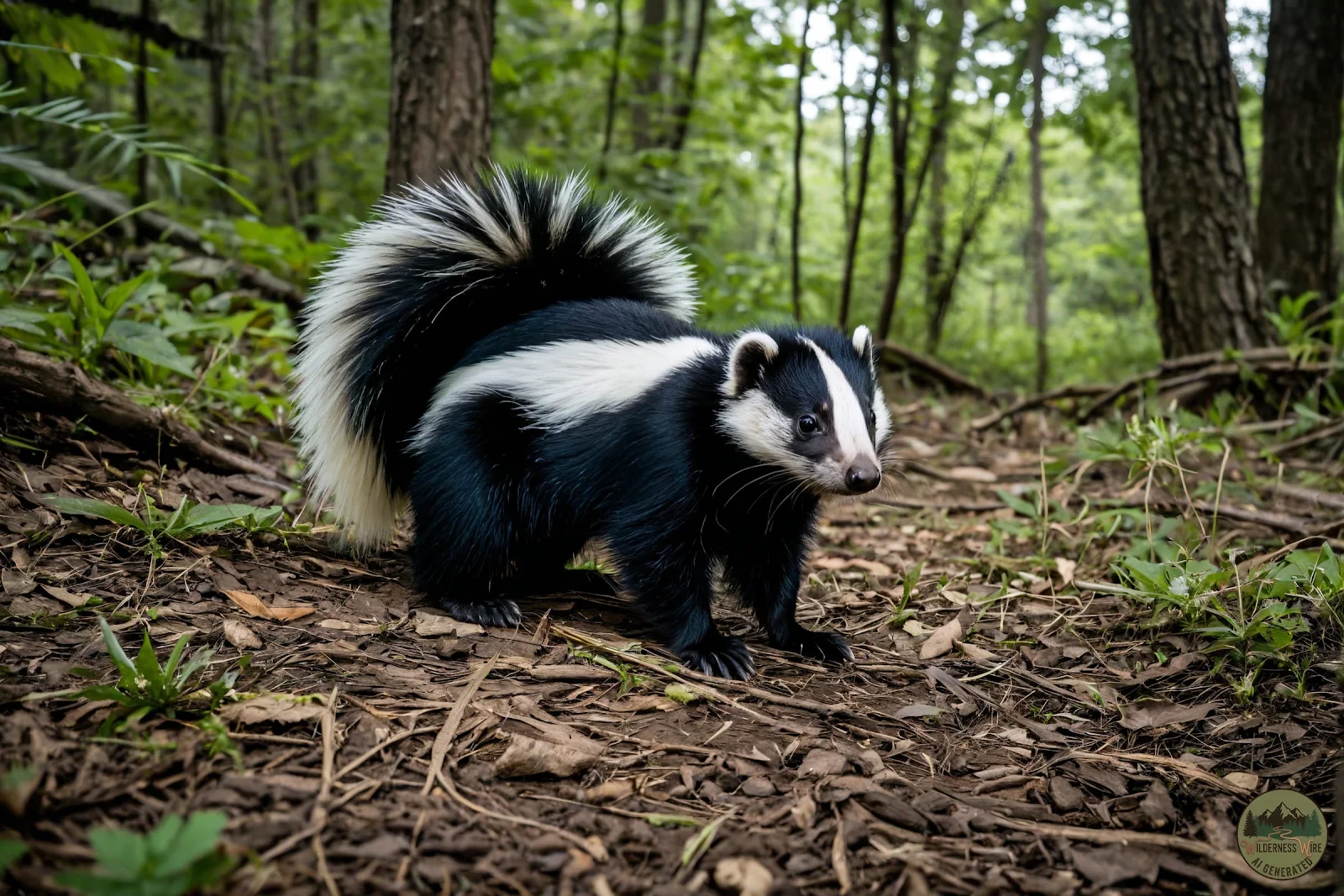
Few animals evoke such an immediate and potent reaction as the skunk. Instantly recognizable by their striking black and white pelage, these small mammals are almost universally associated with their formidable chemical defense. Yet, to reduce the skunk to merely its odoriferous capabilities is to overlook a creature of surprising ecological significance, intricate behaviors, and a generally peaceful disposition. Far from being aggressive, skunks are often misunderstood denizens of the natural world, navigating their nocturnal lives with a quiet determination that extends well beyond their renowned spray.
Belonging to the family Mephitidae, which also includes stink badgers, skunks are characterized by their robust build, relatively short legs, and bushy tails. The most iconic species, the striped skunk (Mephitis mephitis), found widely across North America, typically measures between 40 to 70 cm (15 to 28 inches) in length, including its tail, and weighs between 1.2 to 5.5 kg (2.6 to 12 lbs). Their fur, though primarily black, is adorned with distinctive white stripes or patches, which serve as a clear warning to potential predators. While the striped skunk features two prominent white stripes running down its back, other species, like the spotted skunk (Spilogale putorius), display a more intricate pattern of broken stripes and spots, and are notably smaller and more agile, even capable of impressive handstands as part of their defensive display.
Skunks are remarkably adaptable animals, thriving in a diverse array of habitats across the Americas, from southern Canada to central South America. While they prefer open areas like grasslands, woodlands, and forest edges, they are equally at home in suburban and even urban environments, often taking advantage of human-made structures for shelter. Their dens are typically found in abandoned burrows of other animals, hollow logs, rock crevices, or beneath sheds and porches. This adaptability to human-altered landscapes is a testament to their resilience, though it also frequently brings them into closer contact with people, contributing to both conflict and fascination.
As opportunistic omnivores, skunks possess a varied diet that shifts with the seasons and availability of food. Insects, including grasshoppers, beetles, grubs, and larvae, form a significant portion of their diet, making them valuable natural pest controllers. They also consume rodents, small birds, eggs, reptiles, and amphibians. Beyond animal protein, skunks are fond of fruits, berries, nuts, fungi, and carrion. This eclectic palate not only ensures their survival across different seasons but also highlights their crucial role in local ecosystems, helping to regulate insect and rodent populations while also contributing to seed dispersal through the consumption of fruits.
Skunks are primarily nocturnal, emerging at dusk to forage and returning to their dens before dawn. They are generally solitary animals, though during colder months, females may den together for warmth, sometimes forming small communal groups. Despite their often-maligned reputation, skunks are not inherently aggressive. Their movements are typically slow and deliberate, and they tend to avoid confrontation whenever possible. Their keen senses of smell and hearing compensate for their relatively poor eyesight, allowing them to navigate their nighttime world effectively and locate food sources.
The most defining characteristic of the skunk, and indeed its most effective defense, is its ability to discharge a potent, foul-smelling musk from specialized anal glands located on either side of its anus. This oily, sulfur-containing compound, primarily composed of thiols, is incredibly irritating and can cause temporary blindness, nausea, and a burning sensation if it makes contact with the eyes. A skunk can accurately spray up to 3 to 4 meters (10 to 13 feet) and can deploy multiple sprays within a short period, taking about 10 days to fully replenish its supply after a complete discharge. The spray is not a casual weapon; it is a last resort, an energetically costly endeavor the skunk would prefer to avoid.
Contrary to popular belief, a skunk does not simply spray without warning. Before deploying its noxious arsenal, a skunk will typically engage in a series of escalating deterrent behaviors. These may include hissing, stomping its front feet, clicking its teeth, and raising its tail as a clear signal. Spotted skunks, with their more acrobatic flair, may even perform a handstand, displaying their contrasting coloration and aiming their rear towards the threat. These elaborate warning displays are designed to scare off potential predators without expending their precious, and energetically costly, chemical defense. Only if these warnings are ignored or if the skunk feels directly threatened and unable to escape will it unleash its potent musk.
Skunks typically mate in late winter or early spring, with a gestation period lasting around 60 to 75 days. Litters, usually consisting of four to seven 'kits,' are born blind, deaf, and covered in soft fur, though their distinctive black and white patterns are already visible. The mother, a dedicated and protective parent, raises the young alone in the den. Kits begin to open their eyes and develop their senses after about three weeks and are weaned around two months of age. They will stay with their mother through the summer, learning essential foraging and survival skills, before dispersing in the fall to establish their own territories. In the wild, skunks typically live for two to four years, though they can live significantly longer in captivity.
The close proximity of skunks to human settlements often leads to encounters, both welcome and unwelcome. While their pest control services are beneficial, their denning under homes or the unfortunate incident of a pet getting sprayed can create conflict. Understanding skunk behavior is key to peaceful coexistence. They are generally timid and will retreat if given the opportunity. Providing secure garbage cans, sealing off access points under structures, and keeping pets leashed at night can significantly reduce negative interactions. Should a spraying occur, specific remedies like a mixture of hydrogen peroxide, baking soda, and dish soap are far more effective than traditional tomato juice in neutralizing the thiols.
Beyond their infamous odor, skunks play a vital role in maintaining ecological balance. Their diet, rich in insects and rodents, positions them as natural bioregulators, curbing populations of potential agricultural pests and disease vectors. By consuming carrion, they also act as efficient clean-up crews, preventing the spread of pathogens. The negative stereotype often overshadows their positive contributions, leading to undue fear and misunderstanding. A deeper appreciation for these unique creatures reveals them not as nuisances, but as integral components of the natural world, deserving of respect and protection.
While many skunk species are not currently considered endangered, they do face threats, particularly in areas with high human population density. Road mortality is a significant factor, as their nocturnal habits and slow movement make them vulnerable to vehicles. Habitat fragmentation and loss, along with the indiscriminate use of pesticides that reduce their food sources, also pose challenges. Understanding and mitigating these threats is essential for ensuring healthy skunk populations, reminding us that every creature, no matter how humble or misunderstood, contributes to the intricate web of life.