 Snow Leopard_00001_
High in the remote, jagged peaks of Central Asia, a phantom of the mountains stalks its icy domain. The snow leopard, or *Panthera uncia*, is one of the world's most enigmatic and beautiful big cats, perfectly adapted to thrive in some of the planet's harshest environments. Its very existence is a testament to natural selection, evolving a suite of unique features that allow it to master altitudes ranging from 3,000 to over 5,500 meters across a vast, fractured landscape spanning twelve countries, from the Himalayas to the Altai mountains.
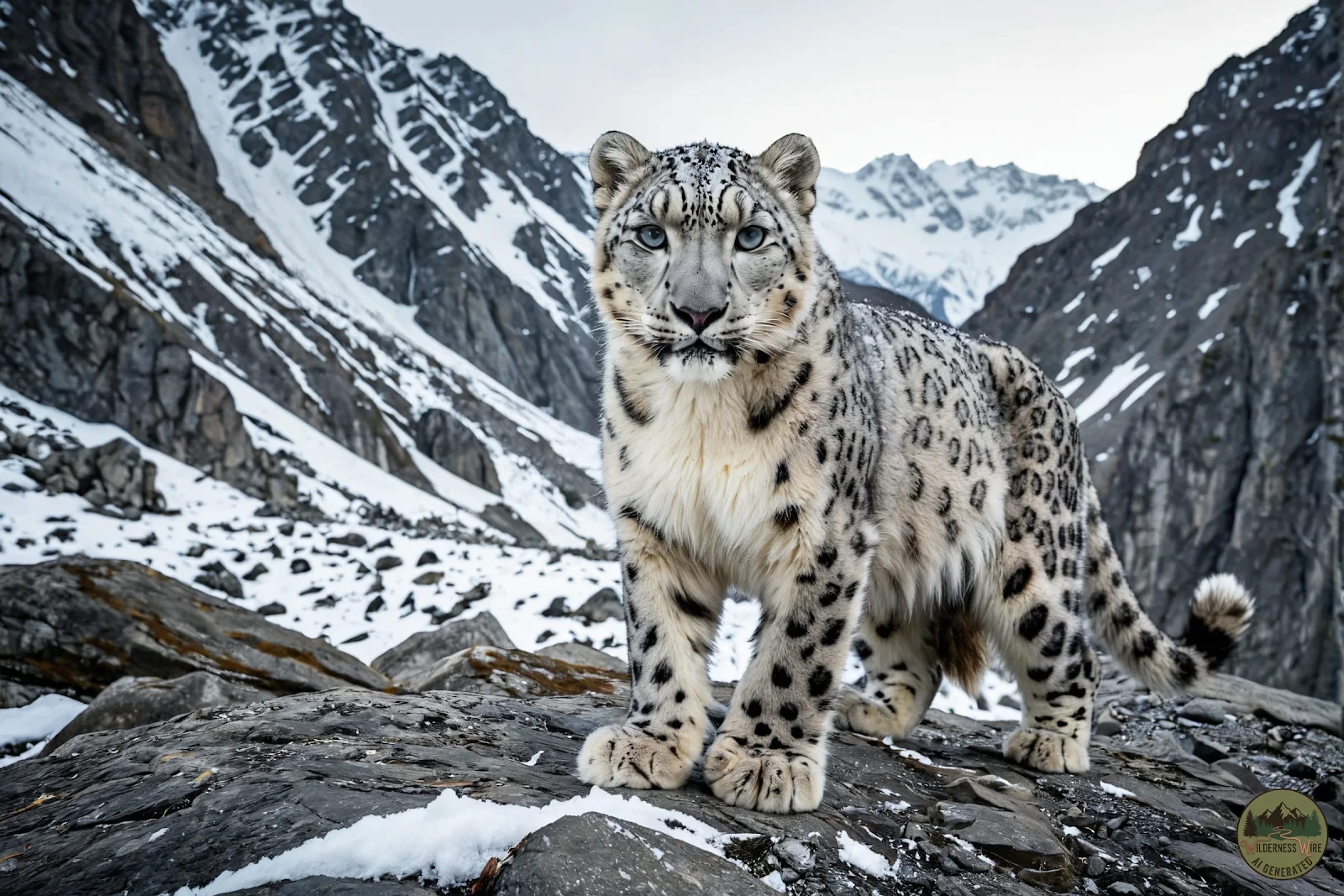
The most striking feature of the snow leopard is its magnificent coat. Thick and dense, it provides unparalleled insulation against the brutal cold, with individual hairs often hollow, trapping air for superior warmth. Its coloration, a smoky grey to cream with a smattering of dark rosettes and spots, offers exceptional camouflage against the snowy, rocky backdrop of its mountainous home. These markings break up its outline, allowing it to disappear seamlessly into the terrain, a critical advantage for an ambush predator. The rosettes are typically more open and widely spaced than those of other big cats like the leopard, further aiding its specific brand of concealment. Beneath this luxurious fur lies a robust, muscular physique, compact and agile despite its power, ideal for navigating treacherous slopes and leaping across chasms.
Its physical adaptations extend to its paws and tail, which are crucial for survival in its extreme habitat. The snow leopard's paws are remarkably large and heavily furred, acting like natural snowshoes to distribute its weight and prevent it from sinking too deeply into the snow. The fur on its paw pads also provides added grip and insulation, protecting against frostbite on frozen surfaces. Perhaps even more remarkable is its tail, which can be almost as long as its body – often measuring up to a meter in length. This thick, muscular appendage serves multiple vital functions. It acts as a counterbalance, allowing the cat to maintain incredible agility and stability while navigating steep, narrow ledges or executing impressive leaps between rocks. When resting or sleeping, the snow leopard often wraps its long, bushy tail around its body and face, providing extra warmth and protection from the biting winds. Furthermore, the tail can store significant fat reserves, a critical adaptation for surviving periods of food scarcity in its lean environment.
Snow leopards are solitary hunters, masters of stealth and surprise. Their diet primarily consists of wild ungulates such as ibex, bharal (blue sheep), argali, and other mountain goats and sheep. When larger prey is scarce, they will opportunistically hunt smaller animals like marmots, pikas, and birds. Their hunting strategy relies on their superior camouflage and acute senses, patiently stalking their prey before launching a powerful, short-range ambush. Despite their relatively moderate size for a big cat (weighing between 27 and 55 kilograms), they possess incredible strength, capable of taking down prey three times their own weight. This is essential for survival in an environment where hunting opportunities can be rare and physically demanding.
The elusive nature of the snow leopard has earned it the moniker "ghost of the mountains." They are primarily crepuscular, most active during dawn and dusk, which further contributes to their infrequent sightings. Their vast territories, often covering hundreds of square kilometers, are marked with scrapes, scat, and scent sprays, communicating their presence to other snow leopards. Due to the challenging terrain and their shy disposition, studying these animals in the wild has always presented significant difficulties for researchers. Advanced camera trapping technologies and genetic analysis from scat samples have revolutionized our understanding of their movements, population dynamics, and behavior, revealing insights into a creature that largely remains a mystery.
Unfortunately, the snow leopard faces a multitude of threats that place its future in peril. Classified as "Vulnerable" on the IUCN Red List, its global population is estimated to be fewer than 10,000 mature individuals, and potentially as low as 2,700, and is declining. Habitat loss and fragmentation are significant concerns, driven by human expansion, infrastructure development, and climate change altering the delicate mountain ecosystems. Poaching remains a persistent threat; these magnificent cats are hunted for their valuable fur, bones (used in traditional Asian medicine), and other body parts in illegal wildlife trade. Human-wildlife conflict also plays a devastating role. As their natural prey declines, snow leopards sometimes predate on livestock, leading to retaliatory killings by herders seeking to protect their livelihoods. Climate change further exacerbates these issues, shifting tree lines higher, altering snowmelt patterns, and impacting the distribution of their prey, pushing the leopards into even smaller, more isolated pockets.
Dedicated conservation efforts are underway across their range, focusing on protecting their habitats, combating poaching through anti-poaching patrols and law enforcement, and working with local communities to mitigate human-wildlife conflict. Educating communities about the value of snow leopards and implementing livestock insurance schemes or predator-proof corrals can significantly reduce retaliatory killings. Establishing protected areas and wildlife corridors helps ensure their survival, but given the vast and rugged nature of their habitat, comprehensive, cross-border cooperation is essential. The future of this magnificent mountain cat depends on a concerted global effort to understand, protect, and coexist with one of nature's most extraordinary adaptations to the high-altitude wilderness.