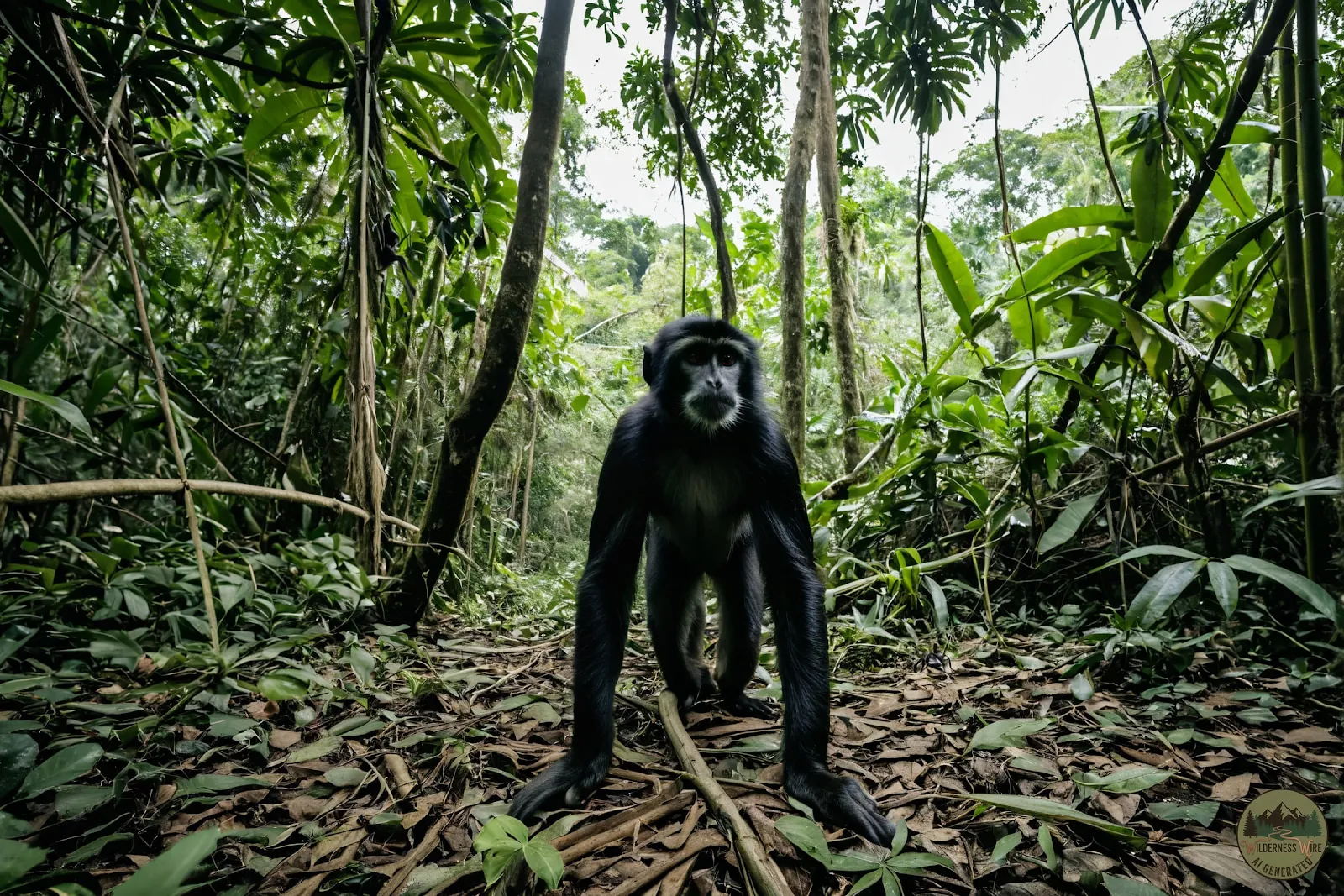
Deep within the verdant canopies of Central and South American rainforests lives a primate renowned for its extraordinary agility and distinctive anatomy: the spider monkey. Belonging to the genus *Ateles*, these New World monkeys are quintessential arborealists, spending virtually their entire lives among the trees, where their specialized bodies allow for a life of unparalleled aerial grace. Their name itself is a testament to their appearance, with exceptionally long, slender limbs and an equally lengthy prehensile tail that evokes the image of a large, hairy spider navigating its web.
The most striking feature of the spider monkey, beyond its gangly limbs, is arguably its prehensile tail. More than just an appendage for balance, this tail functions as a highly sophisticated fifth limb, capable of supporting the monkey's entire body weight, grasping branches, and even plucking fruits. The underside of the tail near its tip is hairless, revealing dermal ridges much like human fingerprints, which provide superior grip and tactile sensitivity. This incredible adaptation allows them to hang effortlessly, survey their surroundings, and manipulate objects with remarkable precision, freeing their hands and feet for other tasks. In the intricate tapestry of the rainforest canopy, such a tool is indispensable for survival.
Another remarkable adaptation that defines their arboreal lifestyle is the absence, or significant reduction, of an external thumb. While seemingly a disadvantage, this evolutionary trait is perfectly suited for their primary mode of locomotion: brachiation. By eliminating the thumb, their remaining four fingers form a natural hook, ideal for swinging arm-over-arm through the branches. Their shoulders are incredibly flexible, providing a wide range of motion necessary for their acrobatic movements. Watching a spider monkey effortlessly glide from one tree to another, covering vast distances with astonishing speed and fluidity, is to witness a masterclass in natural engineering, a testament to millions of years of adaptation to a life lived high above the forest floor.
Spider monkeys are primarily frugivorous, with ripe fruit making up the bulk of their diet. This dietary preference places them in a crucial ecological role as vital seed dispersers. As they consume fruits and travel through their territories, they excrete the seeds, often far from the parent plant, aiding in forest regeneration and maintaining the biodiversity of their ecosystem. While fruit is their staple, they are not exclusively herbivorous; leaves, flowers, nuts, and occasionally small insects or honey supplement their diet, particularly during seasons when fruit is scarce. This varied diet underscores their adaptability and their deep integration into the rainforest's food web.
Their social structure is characterized by what primatologists call "fission-fusion" dynamics. Large groups, which can number up to 30 or 40 individuals, typically split into smaller subgroups for daily foraging activities. This flexible arrangement allows them to efficiently exploit widely dispersed food resources without depleting any single area too quickly. At night or for resting, these smaller groups often coalesce back into larger aggregations. Communication within these complex social networks involves a range of vocalizations, from loud screams that serve as alarm calls or territorial markers, to softer chirps and trills used during social interactions. Facial expressions and body postures also play a significant role in conveying mood and intent.
Spider monkeys exhibit considerable intelligence, a trait often observed in primates with complex social structures and foraging strategies. They have been documented using tools in limited contexts, and their capacity for problem-solving is evident in how they navigate their intricate forest environment to locate food resources. Their intelligence, coupled with their unique physical adaptations, highlights them as highly evolved and specialized inhabitants of the neotropical rainforests.
Sadly, all species of spider monkeys are currently listed as vulnerable, endangered, or critically endangered by the IUCN. Their primary threat comes from extensive habitat loss due to deforestation for agriculture, logging, and mining. As highly arboreal animals, they are particularly sensitive to habitat fragmentation, as it disrupts their ability to travel and find food. Hunting for bushmeat and the illegal pet trade also pose significant dangers to their populations. Given their critical role as seed dispersers, the decline of spider monkey populations has cascading negative effects on the health and resilience of the entire rainforest ecosystem. Conservation efforts, including the establishment of protected areas, anti-poaching initiatives, and community engagement programs, are vital to ensure the survival of these magnificent, acrobatic primates and the vital forest environments they call home.