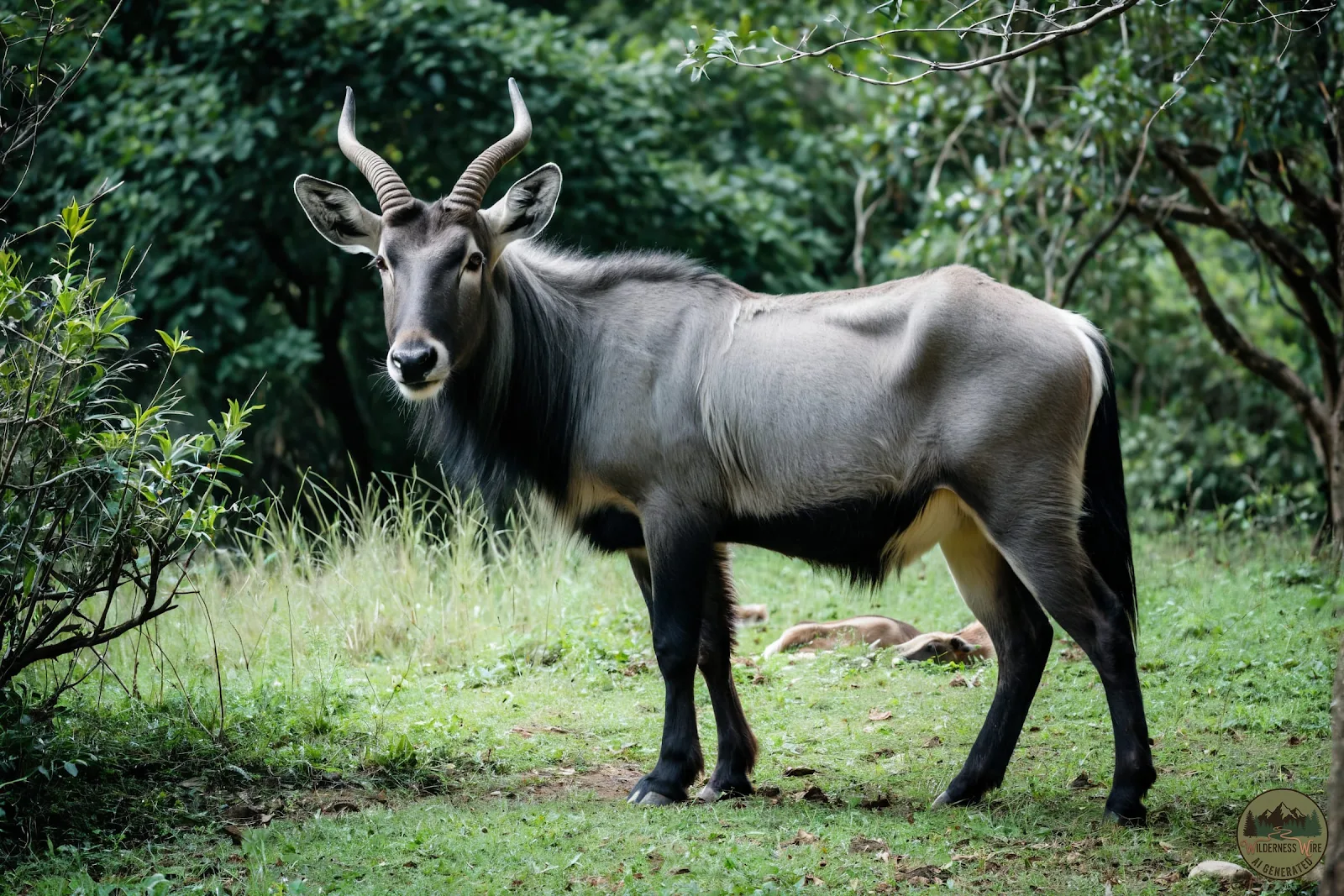
Deep within the steep, unforgiving landscapes of Asia, where mist clings to ancient peaks and dense forests guard hidden ravines, dwells an animal of remarkable resilience and solitary grace: the serow. These captivating goat-antelopes, belonging to the genus *Capricornis*, are master mountaineers, perfectly adapted to a life on the precipice. Often described as a blend of goat, antelope, and perhaps even a touch of mythical beast, the serow possesses a robust physique and an air of quiet determination that allows it to thrive in habitats few other mammals dare to tread. Their elusive nature and preference for rugged, inaccessible terrain make them a truly enigmatic presence in the wild, offering rare glimpses into their complex lives.
The physical appearance of the serow is immediately striking, a testament to its evolutionary journey in demanding environments. They possess a stocky, powerfully built body supported by short, sturdy legs, which might seem counterintuitive for an agile climber, yet these limbs are engineered for explosive power and incredible balance. Their coat, varying in color from dark grey and black to reddish-brown depending on the species and geographical location, is often shaggy and thick, providing vital insulation against the biting cold of high altitudes and protection against abrasive rock faces. A distinctive feature is the long, bristly mane that runs along their back, sometimes extending from the head to the tail, giving them a somewhat archaic, almost prehistoric look. Both males and females sport short, conical horns that curve slightly backward, sharp and formidable tools used for defense against predators and in territorial disputes. Their ears are notably long and pointed, providing excellent auditory senses crucial for detecting danger in their dense and often noisy habitats. Specialized hooves, featuring a soft, rubbery pad and sharp, hard edges, offer superior grip on slick rocks and steep slopes, enabling them to navigate treacherous terrain with astonishing ease and confidence.
Serows are widely distributed across a broad swathe of Asia, from the Himalayan foothills through Southeast Asia, including countries like India, Nepal, Bhutan, China, Myanmar, Thailand, Malaysia, and parts of Indonesia. Their preferred habitat is consistently characterized by steep, rocky slopes, dense forests, and often high altitudes, ranging from sea level in some coastal areas to over 4,500 meters (14,700 feet) in mountainous regions. They are creatures of the forest edge and mountain scrub, often found near permanent water sources. The dense undergrowth provides both camouflage and abundant foraging opportunities, while the precipitous cliffs offer sanctuary from predators like leopards, dholes, and even tigers, which might struggle to follow them into such vertical realms. Their ability to move with astounding dexterity across broken terrain, leaping across chasms and scaling sheer rock faces, underscores their remarkable adaptation to these challenging environments.
As herbivores, serows are primarily browsers, their diet consisting of a wide array of plant material found in their varied habitats. They are not particularly picky eaters, consuming leaves, shoots, twigs, grasses, herbs, mosses, lichens, and ferns. Their foraging habits are opportunistic, adapting to seasonal availability and local flora. This dietary flexibility is crucial for survival in areas where vegetation can be sparse or subject to change. They often feed during the cooler parts of the day, at dawn and dusk, although they may also be active during the day in secluded, undisturbed areas. Their ability to extract nutrients from tough, fibrous plant matter further highlights their rugged constitution and self-reliance in environments that offer limited sustenance for many other large mammals.
Behaviorally, serows are largely solitary animals, preferring to roam their territories alone, though occasionally small groups of a mother and her offspring or a pair may be observed. They are known for their crepuscular activity patterns, being most active during twilight hours, which helps them avoid the heat of the day and also provides a cover of dim light to evade predators. When startled, a serow's first instinct is often to freeze, relying on its natural camouflage to blend into the rocky and forested surroundings. If the threat persists, they will burst into a rapid, agile flight, ascending the steepest slopes with incredible speed and grace. They are highly territorial, marking their home ranges with scent glands located near their eyes and feet, leaving behind olfactory messages for other serows. These territorial displays minimize direct confrontations, acting as a warning system to maintain individual space within their fragmented habitats.
The serow's suite of adaptations for survival goes beyond just their physical attributes. Their keen senses of smell and hearing are vital for detecting predators and locating food in dense vegetation. The strategic placement of their eyes on the sides of their head provides a wide field of vision, allowing them to scan for threats from multiple directions simultaneously, a critical advantage in open, exposed mountain terrain. The thick skull and powerful neck muscles not only support their strong horns but also provide protection during falls or clashes. Their relatively small size compared to other large ungulates allows them to maneuver through dense thickets and crevices where larger animals cannot follow, providing additional refuges. These intricate layers of adaptation, from their specialized hooves to their cautious behavior, paint a picture of an animal honed by millennia of natural selection to conquer some of the planet's most formidable landscapes.
While often referred to simply as "serow," the genus *Capricornis* encompasses several distinct species, each with unique geographical distributions and subtle variations in appearance. Species such as the Himalayan Serow, Chinese Serow, Red Serow, and Japanese Serow all share the fundamental characteristics of their genus but exhibit differences in coat color, size, and horn shape. This diversity underscores the serow's successful adaptation to a wide range of ecological niches across the Asian continent, from the cold, arid heights of the Himalayas to the humid, subtropical forests of Southeast Asia. Each species represents a fascinating chapter in the broader story of the serow, showcasing the subtle interplay between genetics, environment, and evolutionary pressures.
Despite their incredible resilience and adaptability, many serow species face significant threats to their long-term survival. Habitat loss and fragmentation, driven by deforestation for agriculture, human settlements, and infrastructure development, are primary concerns. As their forested mountain habitats shrink and become isolated, serow populations become more vulnerable. Poaching also poses a serious threat, as serows are hunted for their meat, which is consumed locally, and for various body parts used in traditional medicine. Their elusive nature makes it difficult to accurately assess population numbers, but many species are listed as 'Vulnerable' or 'Near Threatened' by the IUCN (International Union for Conservation of Nature), with some facing even greater risk. Conservation efforts focus on protecting their remaining habitats, establishing protected areas, and combating illegal poaching through enhanced law enforcement and community involvement.
In the intricate tapestry of Asia's mountain ecosystems, the serow plays a crucial role as a browser, influencing plant diversity and structure. They are an integral part of the food chain, serving as prey for apex predators, which in turn helps regulate predator populations. The continued existence of serows is a powerful indicator of the health and integrity of these often-fragile high-altitude environments. Their enduring presence in such challenging realms is a testament to nature's ingenuity and the incredible capacity of life to find a way, even in the most demanding conditions. To glimpse a serow navigating a precipitous cliff with effortless grace is to witness a profound harmony between an animal and its wild, rugged home, a truly inspiring sight that underscores the critical importance of preserving these vital wilderness areas for future generations.