The Mysterious Tufted Deer: An Ancient Fanged Species Inhabiting the High Altitude Asian Wilderness
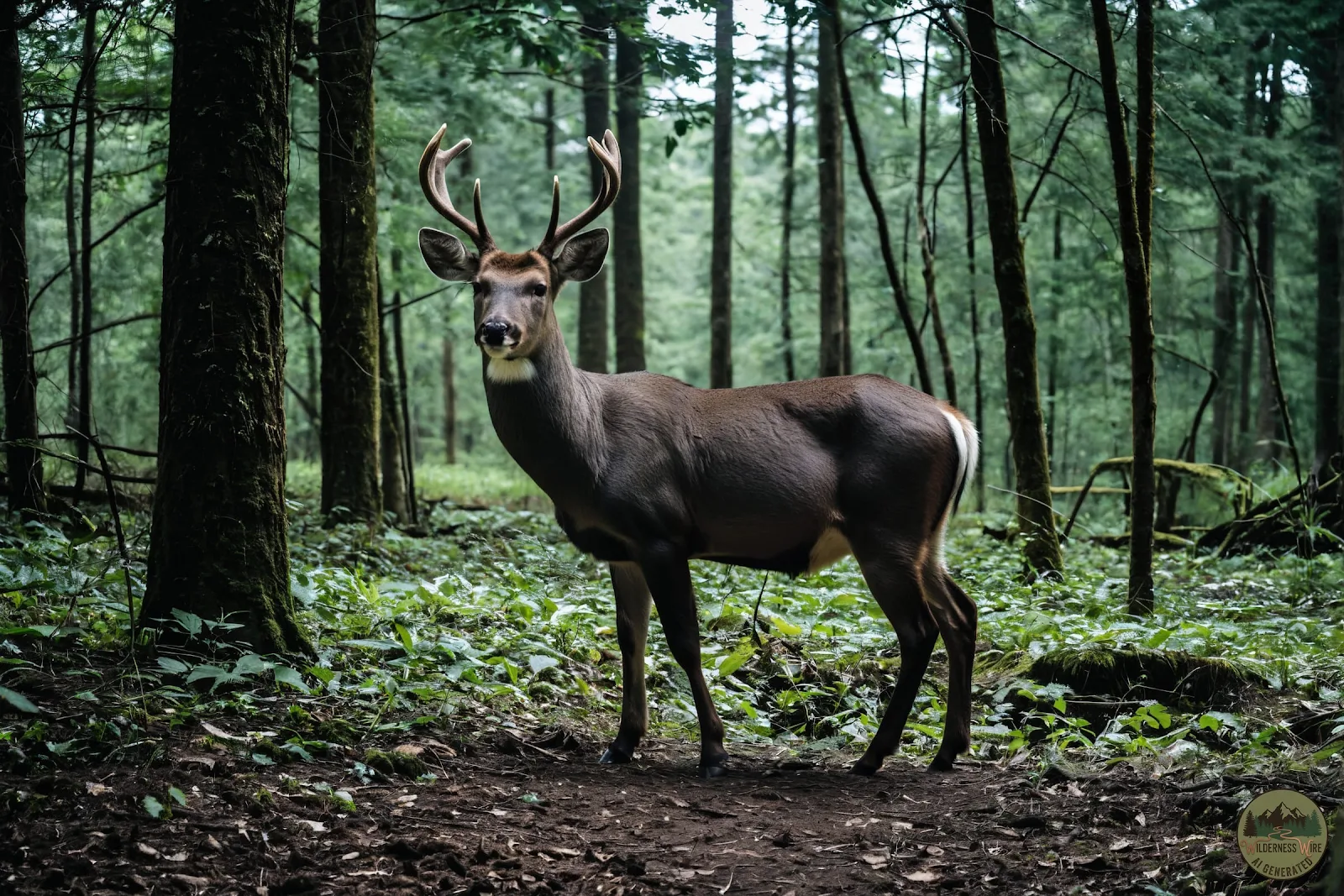
The high-altitude forests of Central and Southern China, reaching into the northernmost corridors of Myanmar, harbor one of the most enigmatic and evolutionarily distinct members of the Cervidae family: the Tufted Deer (Elaphodus cephalophus). While most members of the deer family are recognized by their sweeping antlers or graceful stature, the Tufted Deer presents a morphology that feels like a vestige of a prehistoric era. It is a creature defined by paradoxes—possessing a gentle, shy disposition while bearing prominent, saber-like canine teeth that have earned it a somewhat sensationalized reputation in amateur natural history circles.
Belonging to the subfamily Cervinae and closely related to the muntjacs, the Tufted Deer is the only member of its genus, Elaphodus. Its physical appearance is striking, characterized by a coat of coarse, almost chocolate-brown or charcoal hair that provides exceptional camouflage against the damp, shaded floors of montane forests. The animal’s name is derived from the horseshoe-shaped tuft of long, dark hair on its forehead, which can grow up to 17 centimeters in length. This tuft often obscures the animal’s antlers, which are notably small and unbranched, sitting atop long pedicles. In many ways, the Tufted Deer represents a middle ground in deer evolution, retaining primitive features that more specialized modern deer have long since discarded.
Perhaps the most startling feature of the species, particularly in males, is the presence of enlarged superior canine teeth. These "tusks" can grow over an inch long and protrude downward from the upper jaw, visible even when the mouth is closed. From an evolutionary perspective, these fangs are not predatory tools but are used as weapons during the breeding season. In the dense, tangled undergrowth of high-elevation forests, large, sprawling antlers would be a physical liability, easily snagged on branches and vines. By maintaining sharp canines and reduced antlers, the Tufted Deer can effectively defend territory and compete for mates without sacrificing its mobility in a cluttered environment. This trade-off—fangs over antlers—is a hallmark of the more ancestral deer lineages.
The habitat of the Tufted Deer is as specialized as its physiology. They are typically found at elevations ranging from 300 to 4,500 meters, favoring damp, evergreen broadleaf forests and mixed coniferous-deciduous woodlands. They are rarely found far from a water source. These regions are characterized by steep terrain and high humidity, often cloaked in mist for much of the year. The deer’s coat is specially adapted for this climate; the hairs are somewhat hollow and stiff, providing a layer of insulation against the mountain chill while repelling the persistent moisture of the cloud forests.
Behaviorally, the Tufted Deer is a crepuscular animal, meaning it is most active during the twilight hours of dawn and dusk. This schedule helps it avoid many of its natural predators, which include leopards and dholes. When startled, the Tufted Deer exhibits a unique flight response. It emits a sharp, barking sound—not unlike a small dog—that serves as an alarm to others in the vicinity. As it runs, it flips its tail with every bound, revealing the stark white underside. This "white-flagging" behavior is common among many deer species and is thought to serve as a visual signal to a predator that it has been spotted, or perhaps as a beacon for a fawn to follow its mother through the dense brush.
Dietarily, the species is a browser. It consumes a wide variety of vegetation, including grasses, herbs, fruits, and the tender shoots of bamboo. Because they live in environments where seasonal changes can be harsh, their diet is opportunistic. During the winter months, they may rely more heavily on twigs and bark. Their digestive system, like that of other ruminants, is highly efficient at extracting nutrients from fibrous plant material, allowing them to thrive in rugged landscapes where higher-quality forage might be scarce.
The social structure of the Tufted Deer is predominantly solitary. They are territorial animals, with males marking their range using preorbital glands located just in front of the eyes. These glands secrete a scent that informs other deer of the individual’s presence and reproductive status. While they are usually seen alone, they may travel in pairs during the mating season, which typically occurs in late autumn or early winter. Following a gestation period of approximately 180 days, a single fawn is usually born in the late spring or early summer. The fawns are born with a pattern of spots that helps them blend into the dappled sunlight of the forest floor, though these spots fade quickly as they mature, reaching adult coloration within a few months.
Conservation status for the Tufted Deer is currently listed as Near Threatened or Data Deficient depending on the specific region. While they are not as critically endangered as some of their cousins, such as the Milu or the South China Tiger, they face significant threats from habitat fragmentation. As human agricultural activities and logging move higher up the mountain slopes, the pristine corridors of old-growth forest the deer rely on are being diminished. Furthermore, although protected by law in China, they are occasionally subject to poaching for their hides and meat. The difficulty of studying them in their rugged, remote habitat means that accurate population surveys are hard to come by, making it challenging for conservationists to implement targeted protection strategies.
Understanding the Tufted Deer requires looking beyond its "vampire" moniker and appreciating it as a master of niche adaptation. It is a specialist of the shadows, a creature that has remained relatively unchanged for millions of years because its design—compact, agile, and armed for close-quarters defense—is perfectly suited for the vertical jungles of Asia. To preserve the Tufted Deer is to preserve the integrity of the montane ecosystem itself; it is a sentinel of the high woods, a quiet reminder of the diverse and often strange paths that evolution takes when faced with the challenges of the mountain wilderness.
As research continues, particularly through the use of non-invasive camera trapping and genetic analysis, we are beginning to learn more about the four recognized subspecies of Elaphodus cephalophus. Each occupies slightly different geographical ranges, from the Ichang tufted deer in the east to the Burmese tufted deer in the west. These variations in size and coat color suggest that the species is still actively adapting to the micro-climates of the various mountain ranges it inhabits. For the naturalist and the scientist alike, the Tufted Deer remains a compelling subject—a living link to the ancient forests of the Cenozoic era, still barking into the mists of the Chinese highlands.