The Fanged Tufted Deer An Ancient and Elusive Species of the Asian Mountain Forests
Deep within the mist-shrouded, high-altitude forests of central China and northeastern Myanmar dwells a creature that seems to belong to a lost era of mammalian evolution. The tufted deer (Elaphodus cephalophus) is a small, elusive member of the Cervidae family that challenges the conventional aesthetic of deer species. While most deer are celebrated for their sweeping, ornate antlers, the tufted deer is defined by a more archaic and striking set of features: a prominent crown of dark hair and elongated, saber-like canine teeth that lend it a distinctive, almost otherworldly appearance.
Tufted Deer_00001_
Taxonomically, the tufted deer is the sole member of its genus, Elaphodus, and is closely related to the muntjacs. These two groups represent some of the most primitive lineages of deer still in existence today. Evolutionarily, they occupy a middle ground between the hornless musk deer and the "modern" cervids that rely primarily on large antlers for defense and sexual selection. In the tufted deer, we see a fascinating evolutionary trade-off; because it inhabits dense, tangled undergrowth where large antlers would be a hindrance to movement, it has retained the ancestral trait of tusks—enlarged upper canines that can grow up to an inch in length in males.
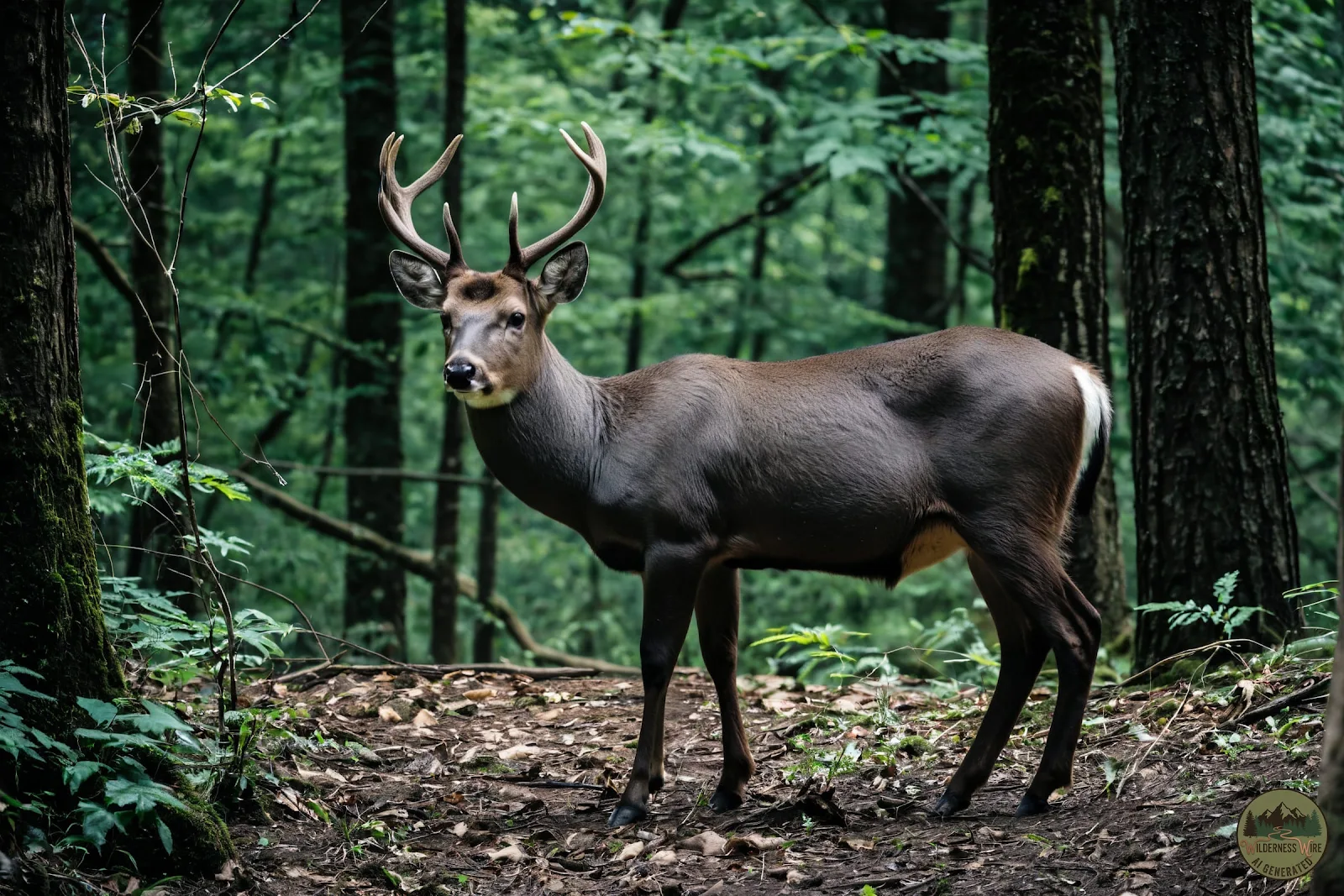
The physical profile of the tufted deer is one of specialized adaptation. Its coat is composed of coarse, almost bristly hair, typically deep chocolate brown or slate gray in color. This provides excellent camouflage against the damp bark and shadowy leaf litter of the mountain temperate forests. The "tuft" for which it is named is a horseshoe-shaped clump of black-brown hair on its forehead, which can reach up to 17 centimeters in height. This tuft often obscures the animal’s antlers, which are so small and rudimentary that they are frequently overlooked entirely. These tiny spikes are unbranched and rarely protrude beyond the tuft, making the deer’s "fangs" its most visible and formidable attribute.
The habitat of the tufted deer is as specific as its morphology. They are found almost exclusively in high-altitude environments, ranging from 300 to 4,500 meters above sea level. They favor damp, evergreen broadleaf forests and mixed needle-leaf forests, particularly those with a thick understory of bamboo or rhododendron. These environments are characterized by high humidity and frequent fog, conditions that help the deer remain undetected by predators. Their range is largely restricted to the mountainous regions of China, spanning from the coast in the east to the eastern edges of the Tibetan Plateau, with smaller populations extending into Myanmar.
Behaviorally, the tufted deer is a creature of solitude. They are primarily crepuscular, meaning they are most active during the dim light of dawn and dusk. This schedule minimizes their exposure to large predators like leopards and dholes. When startled, the tufted deer exhibits a unique fleeing mechanism: it emits a sharp, barking sound—similar to a dog—before running in a series of "bouncing" leaps. As it runs, it flips its tail up, exposing the bright white underside. This flash of white acts as a visual signal to other deer, or perhaps a distraction to the predator, before the animal vanishes back into the impenetrable brush.
Dietary habits are consistent with its forest-dwelling nature. The tufted deer is a specialized browser, consuming a variety of grasses, herbs, fruits, and the tender leaves of shrubs. Because they live in environments that experience significant seasonal changes, their diet shifts with the availability of vegetation. During the harsh mountain winters, they rely on twigs and dried leaves, their hardy digestive systems capable of extracting nutrients from relatively low-quality forage. Their small body size—standing only about 50 to 70 centimeters at the shoulder—means they require less total caloric intake than larger deer, but they must feed frequently to maintain their metabolism in the cold mountain air.
The reproductive cycle of the tufted deer is timed to ensure the survival of the fawns during the most temperate months. The mating season, or rut, typically occurs in late autumn or early winter. During this time, males use their barking calls to attract mates and may use their sharp canines in ritualized combat with rival males. These "tusks" are used to slash at the neck and head of opponents, a much more direct and potentially injurious form of combat than the antler-shoving matches seen in elk or deer. After a gestation period of about six months, a single fawn is born in the late spring or early summer. Unlike many other deer species, the fawns do not always have prominent white spots, or if they do, the spots fade very quickly as they mature, helping them blend into the shadows of the forest floor.
From a conservation perspective, the tufted deer is currently classified as "Near Threatened" by the IUCN. While they are not as critically endangered as some of their Asian forest neighbors, they face significant pressures from habitat loss and overexploitation. The expansion of agricultural land and logging in China’s mountainous provinces has fragmented their habitat, isolating populations and making them more vulnerable to local extinction. Furthermore, they are often hunted for their meat and skins. Because they are so secretive and inhabit such rugged terrain, conducting accurate population surveys is immensely difficult, meaning their true numbers may be lower than current estimates suggest.
The tufted deer serves as a vital indicator species for the health of high-altitude forest ecosystems. Its presence suggests a forest with enough structural complexity to provide cover and a diverse range of plant life for forage. Protecting the tufted deer requires a broad approach to forest management, focusing on the preservation of the "green corridors" that allow isolated populations to interact and maintain genetic diversity. As climate change shifts the boundaries of mountain ecosystems, the tufted deer's ability to adapt to new altitudinal ranges will be a subject of great interest to biologists and conservationists alike.
To witness a tufted deer in the wild is a rare privilege. It is an animal that embodies the mystery of the deep woods—a relic of an ancient evolutionary path that reminds us of the sheer diversity within the world of ungulates. Its combination of delicate features and sharp "fangs" serves as a testament to the complex requirements of survival in some of the most beautiful but demanding landscapes on Earth. By studying and protecting this unique species, we preserve not just a biological curiosity, but a vital link to the natural history of the Asian continent.