The Tusked Water Deer: A Primitive Relict Species Thriving in the World’s Wetlands
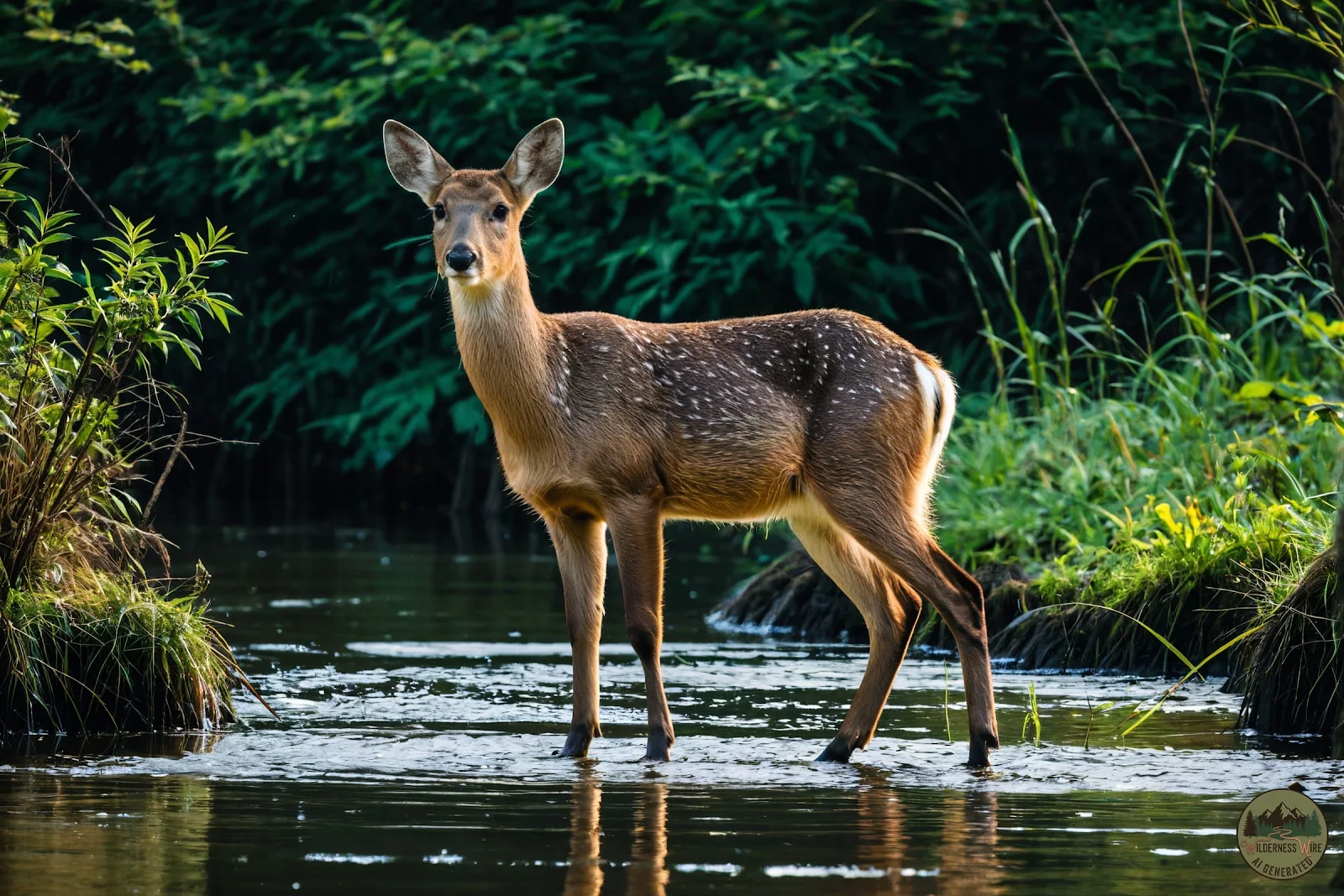
The natural world is replete with evolutionary anomalies that challenge our standard definitions of animal families. Within the family Cervidae, which includes familiar giants like the moose and the elegant red deer, exists a creature that appears to have wandered out of a prehistoric epoch. The Water Deer (Hydropotes inermis) is a small, primitive deer that lacks the most defining characteristic of its kin—antlers. In their place, this species has developed elongated, saber-like upper canine teeth, granting them an appearance that is as striking as it is unusual.
Taxonomically, the Water Deer occupies a unique position. It is the sole member of the genus Hydropotes, often described by biologists as a "relict" species. This means it has retained several primitive morphological traits that other deer species lost millions of years ago as they evolved more modern defensive structures. While most male deer (and some females, in the case of reindeer) invest significant metabolic energy into growing and shedding complex deciduous antlers each year, the Water Deer has maintained the ancestral state of the cervid lineage: the reliance on cranial weaponry in the form of tusks.
These tusks, or "canines," are found in both sexes, though they are significantly more prominent in males. In a mature buck, these ivory weapons can reach lengths of up to eight centimeters. Unlike the fixed teeth of most mammals, the Water Deer’s tusks are held somewhat loosely in their sockets and are controlled by fine facial muscles. This allows the deer to move the tusks backward while eating or to bring them forward and outward during confrontations. When two males compete for territory or breeding rights, they do not clash heads as antlered deer do. Instead, they engage in a ritualized "slashing" combat, standing shoulder to shoulder and attempting to strike the neck or shoulders of their opponent with their downward-pointing sabers. This behavior is a fascinating glimpse into the early evolution of deer, before the development of the "locking" mechanisms provided by antlers.
The habitat requirements of the Water Deer are equally specific, as reflected in their common name. They are highly specialized for life in riparian environments, favoring reed beds, marshlands, and the lush vegetation found along riverbanks and coastal areas. Their physiology is finely tuned to these damp ecosystems. They are exceptional swimmers, capable of traveling several kilometers between islands or across wide estuaries to find new feeding grounds. Their hooves are adapted for soft, muddy terrain, spreading wide to provide better weight distribution on unstable ground, much like a natural snowshoe for the wetlands.
Geographically, the species is divided into two recognized subspecies: the Chinese Water Deer (Hydropotes inermis inermis) and the Korean Water Deer (Hydropotes inermis argyropus). In their native ranges, they face significant conservation challenges. In China, habitat fragmentation and the conversion of wetlands for agriculture have historically led to a decline in numbers, though recent conservation efforts and the establishment of protected areas have begun to stabilize some populations. In Korea, the situation is more complex; while they are common in the wild, they are often viewed as agricultural pests, leading to conflicts with local farming communities.
An interesting chapter in the history of the Water Deer is their establishment in the United Kingdom. Escaping from private collections and zoological parks in the late 19th and early 20th centuries, a wild population became firmly established in the wetlands of East Anglia and Bedfordshire. Remarkably, it is estimated that a significant percentage of the global population of Chinese Water Deer now resides in the British countryside. These populations serve as a vital genetic reservoir for the species, providing a safeguard against the fluctuations and threats faced by the populations in mainland Asia.
The reproductive strategy of the Water Deer further distinguishes it from its relatives. While most deer species typically give birth to one or two fawns, the Water Deer is remarkably prolific. It is not uncommon for a healthy doe to produce a litter of three or four fawns, and there have even been recorded instances of up to seven. This high reproductive rate is an evolutionary adaptation to the high mortality rates associated with their specific wetland habitats, which are often subject to flooding and high predator density. The fawns are born with a camouflage pattern of white spots and stripes that mimics the dappled light of the reed beds, allowing them to remain virtually invisible to predators during their first few weeks of life.
Dietary habits of the Water Deer are characterized by high selectivity. They are concentrate selectors, meaning they choose the most nutritious parts of plants—young shoots, tender leaves, and energy-rich herbs—rather than grazing on bulk forage. This selective feeding allows them to maintain their high metabolism and supports the energy-intensive process of rearing multiple offspring. Because they lack a rumen as large as those of more grazier-oriented deer, they must feed frequently, often being most active during the crepuscular hours of dawn and dusk.
To observe a Water Deer in the wild is to witness a master of stealth. They are notoriously shy and solitary animals. Unlike the social herds of fallow or red deer, Water Deer are typically seen alone or in small family groups. Communication is largely olfactory and auditory rather than visual. They possess prominent scent glands in front of their eyes and between their toes, which they use to mark territories. When startled or communicating with others, they produce a range of sounds, from a sharp, dog-like bark to a shrill whistle. The bark is particularly startling to those unfamiliar with the species, as it sounds remarkably like a large canine emanating from the tall grass.
In conclusion, the Water Deer is a living testament to the diversity of evolutionary paths. By retaining their tusks and perfecting their niche in the world's wetlands, they offer scientists and nature enthusiasts a window into the past. Their existence highlights the importance of wetland conservation, as these specialized ecosystems are the only places where such unique evolutionary experiments can continue to thrive. Whether hiding in the reeds of the Yangtze River or the fens of Norfolk, the Water Deer remains one of the most enigmatic and captivating members of the animal kingdom.